
Key takeaways from Demystifying AI in Architectural Design event
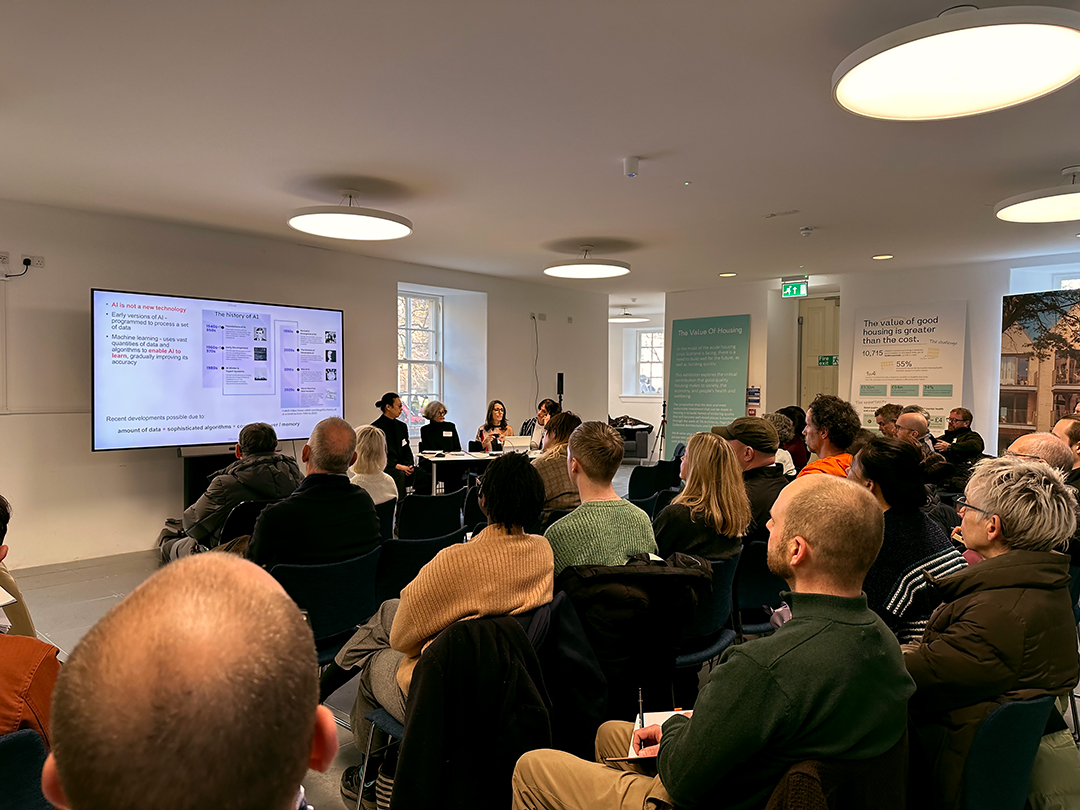
On 12 November 2026, A&DS hosted Demystifying AI in Architectural Practice at A&DS:SpACE at the Edinburgh Futures Institute, bringing together researchers, practitioners, academics and designers to explore one of the most significant questions facing the profession today: how will artificial intelligence shape the future of architectural practice?
The discussion ranged from practical applications already emerging in design studios to wider questions around ethics, accountability, professional identity and the future of cities. While views differed on the pace and scale of change, there was broad agreement on one point: AI is becoming an increasingly important tool, but human judgement remains at the heart of good design.
Below the short video are five key themes from the event.
Demystifying AI in Architectural Design: summary video
Here is a short video from the event, capturing some of the key themes and discussions from the day.
Video credit: RobMcDougall.com
Most practices remain cautious adopters
Artificial intelligence is often spoken about as a single technology, but it is better understood as an umbrella term encompassing a wide range of tools, models and applications. While AI has existed in various forms since the 1950s, recent advances in generative technologies have accelerated interest across the design professions.
Despite the attention it receives, AI adoption in architecture remains relatively early. Research presented during the event suggested that most practices are currently experimenting with AI rather than embedding it strategically within their operations. Only a small number have invested in the infrastructure, skills and processes needed to integrate AI into everyday practice.
Where AI is being used, applications are typically concentrated in four areas:
- Writing and research: information management, report writing, briefing and project administration.
- Visualisation: rapid ideation, concept testing and transforming sketches into visual outputs.
- Generative design: analysing complex datasets, exploring development opportunities and supporting site analysis.
- Communication and coordination: automating repetitive tasks, supporting multidisciplinary collaboration and aiding public engagement.
Used effectively, these tools have the potential to improve efficiency, support decision-making and help smaller practices access capabilities previously associated with larger organisations. However, AI is not yet embedded across the full design process and remains some distance from becoming an indispensable part of every project team.
AI is creating opportunities, but not replacing architects
One of the clearest messages from the discussion was that AI should be viewed as a means of augmentation rather than replacement.
Participants highlighted the growing potential of AI to process large datasets, model complex systems and generate design options at a speed that would previously have been impossible. Looking ahead, predictive tools could support planning decisions by modelling flood risk, climate impacts, mobility patterns and other interconnected challenges.
AI may also help practitioners explore future scenarios, communicate ideas more clearly and support more collaborative approaches to design. Emerging tools are increasingly capable of helping multidisciplinary teams understand complex relationships within places and test alternative approaches before decisions are made.
Yet opportunities come with important limitations. AI-generated outputs can create the impression that a design issue has been resolved when significant questions remain unanswered. While the quality of generated imagery and text continues to improve, accuracy, context and professional judgement still require human oversight.
Rather than providing answers, AI is often most valuable as a tool for exploration, helping teams generate options, test assumptions and frame better questions.
Human judgement remains irreplaceable
Perhaps the most interesting theme to emerge from the event centred on the future role of the architect.
As AI takes on more routine and repetitive tasks, architects may spend less time producing every individual output and more time directing, evaluating and connecting different forms of expertise. Several speakers described this evolving role as that of a "choreographer" of design: someone who orchestrates tools, disciplines and processes while maintaining responsibility for outcomes.
This reflects a broader question about what remains uniquely human in architectural practice.
Understanding the character of a place, interpreting a client's ambitions, engaging with communities and defining a vision all require qualities that cannot easily be automated. Visiting sites, observing how places function and understanding local context remain fundamental parts of the design process.
Creativity is not simply the ability to generate options. It involves determining which questions matter, identifying appropriate solutions and exercising professional judgement. While AI may support many stages of design, critical thinking, spatial understanding and contextual awareness remain essential to creating successful places.
New specialist roles will undoubtedly emerge as AI develops, but responsibility, accountability and professional expertise continue to rest with people, not machines.
Significant ethical and practical challenges remain unresolved
Alongside enthusiasm for new possibilities, participants were clear-eyed about the risks and challenges associated with AI.
Concerns raised during the discussion included:
- Copyright and intellectual property issues.
- Embedded biases within training data.
- Ethical questions around transparency and consent.
- The environmental impact of energy-intensive computing infrastructure.
- Potential impacts on employment, particularly for visualisers, junior staff and recent graduates.
There were also concerns about the growing expectation that projects can be delivered faster and more cheaply through technology. If AI reduces time spent on administration, should that value be reinvested in creativity, communication and engagement, or simply used to reduce project budgets?
Questions of trust and accountability remain particularly important. AI systems can produce inaccurate information and are prone to "hallucinations" and other errors. As a result, outputs require careful verification and review.
Ultimately, AI carries no professional responsibility for the consequences of a design decision. Accountability remains with the architects, designers and organisations that choose to use these tools.
Participants also reflected on the need to consider not only whether AI can be used, but whether it should be used. Overreliance on generic tools risks producing generic outcomes, reducing authenticity and weakening the site-specific thinking that underpins good design.
Practices need clear strategies for adoption
As AI becomes more prevalent, architecture and design practices will need to develop clearer approaches to its use.
There was broad agreement that organisations should consider how AI aligns with their values, business objectives and ways of working, rather than adopting technologies simply because they are available.
Practical considerations may include:
- Developing ethical frameworks and governance policies.
- Establishing review and quality assurance processes.
- Building AI literacy and skills across teams.
- Identifying where AI genuinely adds value within project workflows.
- Balancing efficiency gains with design quality and professional responsibility.
Larger multidisciplinary firms are already beginning to formalise their approaches, while smaller practices may benefit from remaining agile and selectively adopting tools that address specific needs.
Rather than prescribing a single approach, the discussion highlighted the value of developing practical guidance and guardrails that help practices understand both the opportunities and risks associated with different applications.
AI adoption should not become an expectation for every practice. Different organisations have different priorities, resources and operating models, and successful implementation is likely to look different for each.
Looking ahead
The event demonstrated that the conversation around AI in architecture is only just beginning.
While today’s most visible applications tend to focus on visualisation, research and administrative support, the longer-term implications could be far more significant. AI may help practitioners better understand complex systems, respond to climate challenges, engage communities and explore new ways of designing places.
At the same time, the discussion reinforced the enduring importance of human skills. Understanding context, applying judgement, working collaboratively and imagining better futures remain central to architectural practice.
The challenge for the profession is not simply whether to adopt AI, but how to do so responsibly, critically and in ways that enhance rather than diminish the value of human creativity.
Key takeaways
- Most architectural practices are still experimenting with AI rather than adopting it strategically.
- AI is creating opportunities across research, visualisation, administration and design exploration.
- Human judgement, creativity and contextual understanding remain fundamental to good design.
- Ethical, environmental, legal and professional challenges must be addressed alongside technological adoption.
- The role of the architect is evolving, with increasing emphasis on directing, evaluating and integrating AI-enabled workflows.
Download
Download this two-page takeaway from the Demystifying AI in Architectural Design event.
Published November 2026 (157 KB)
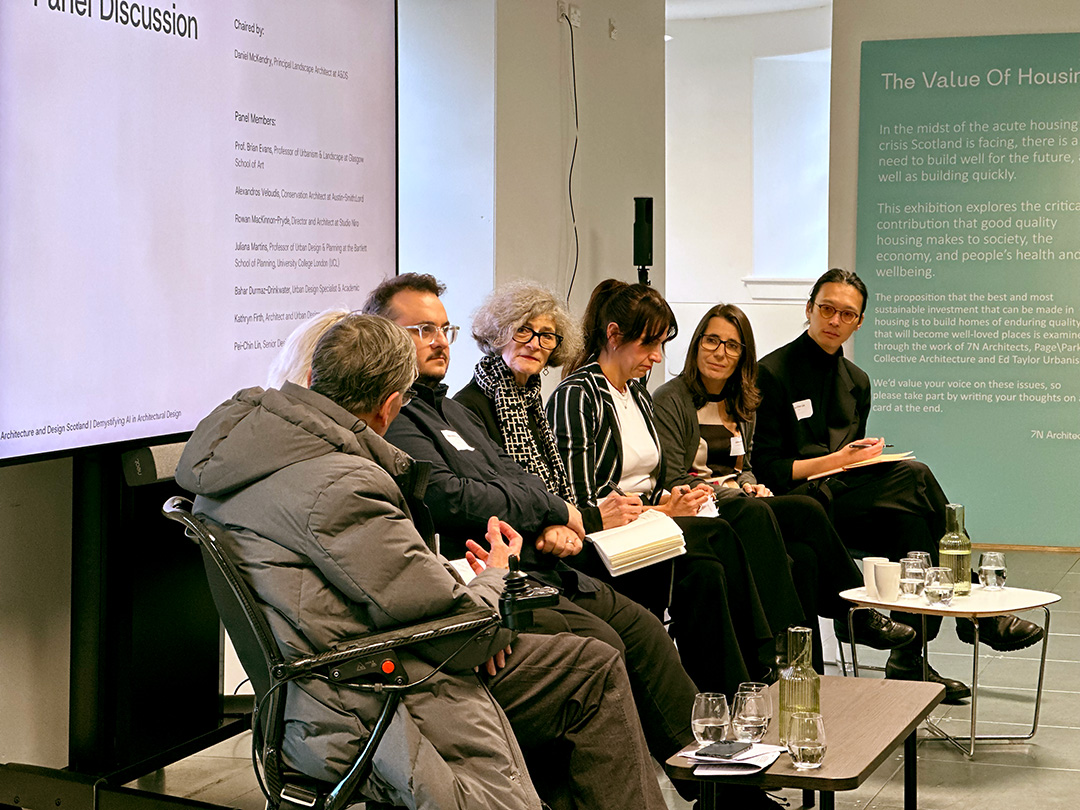
With thanks to all presenters, panellists and attendees for contributing to a valuable and thought-provoking discussion.
Presentations were delivered by Dr Juliana Martins, Professor of Urban Design and Planning at the Bartlett School of Planning, University College London (UCL); Dr Bahar Durmaz-Drinkwater, Urban Design Specialist and Academic; Kathryn Firth, Architect and Urban Designer; and Pei-Chin Lin, Senior Designer at Arup.
The panel discussion was facilitated by Danny McKendry and included the speakers above, alongside Professor Brian Evans of the Mackintosh School of Architecture, Rowan Mackinnon-Pryde of STUDIO NIRO and Alexandros Veloudis of Austin-Smith:Lord.